
Is Sp5der Stands as the High-End Brand or Urban Fashion
The matter seems simple enough before you genuinely attempt to tackle it: is Sp5der qualify as a designer label or a street-inspired label? As of 2026, that discussion grows increasingly difficult to answer because the both categories are bleeding into each other across many years, and Sp5der occupies a intriguing place directly at that boundary. The brand commands costs that ordinary fashion shoppers could connect with luxury — sp5der hoodies generally sell between $150 and $350, and secondary market values rise much higher for desirable color options. Still, the retail model, the graphic identity, the cultural following, and the genesis story all seem clearly embedded in street culture. Heritage houses run from established houses; Sp5der grew out of rap roots and launch model. But, categorizing it just streetwear appears limiting given the prices, the cultural prestige, and how the label has been embraced by the style observers. This is nowhere near a question with a neat answer — it is a question that illuminates much that is deeply significant about where style categories are moving in the contemporary moment.
What Exactly Defines a Name “High-End” in the Current Era
Before positioning Sp5der along a particular scale, it is useful interrogating what luxury actually represents in 2026, because the meaning has evolved dramatically from what it was even a decade ago. Classic high-end brands — think Hermès, Louis Vuitton, Chanel — is built on a particular foundation: brand history story, skilled construction, limited availability through flagship stores, and prices that signal total scarcity to the general public. The materials are premium, the construction is demonstrable, the lineage is deep, and the purchasers is effectively characterized by affluence. Contemporary high-end fashion has disrupted this structure, as houses like Off-White, Palm Angels, and Balenciaga showed that street-inspired aesthetic and high-end pricing can coexist seamlessly. Scarcity, cultural currency, and influencer connection have emerged as new cornerstones for luxury pink hoodie spider branding, standing alongside or displacing the traditional pillars of legacy and artisanal production. In this broadened understanding of premium branding, Sp5der meets the criteria on multiple criteria: it is hard to obtain, it is culturally connected, it achieves substantial prices, and it delivers meaningful social signaling currency. That said, Sp5der does not carry the artisanal origin story, the tailored craftsmanship benchmarks, or the aspirational class marker that marks heritage high-end houses. The premium question is really about which definition you apply — the traditional one or the evolving new one — and thoughtful grappling with that matter demonstrates more than any straightforward affirmative or negative response.
What Exactly Defines Sp5der Unquestionably Streetwear
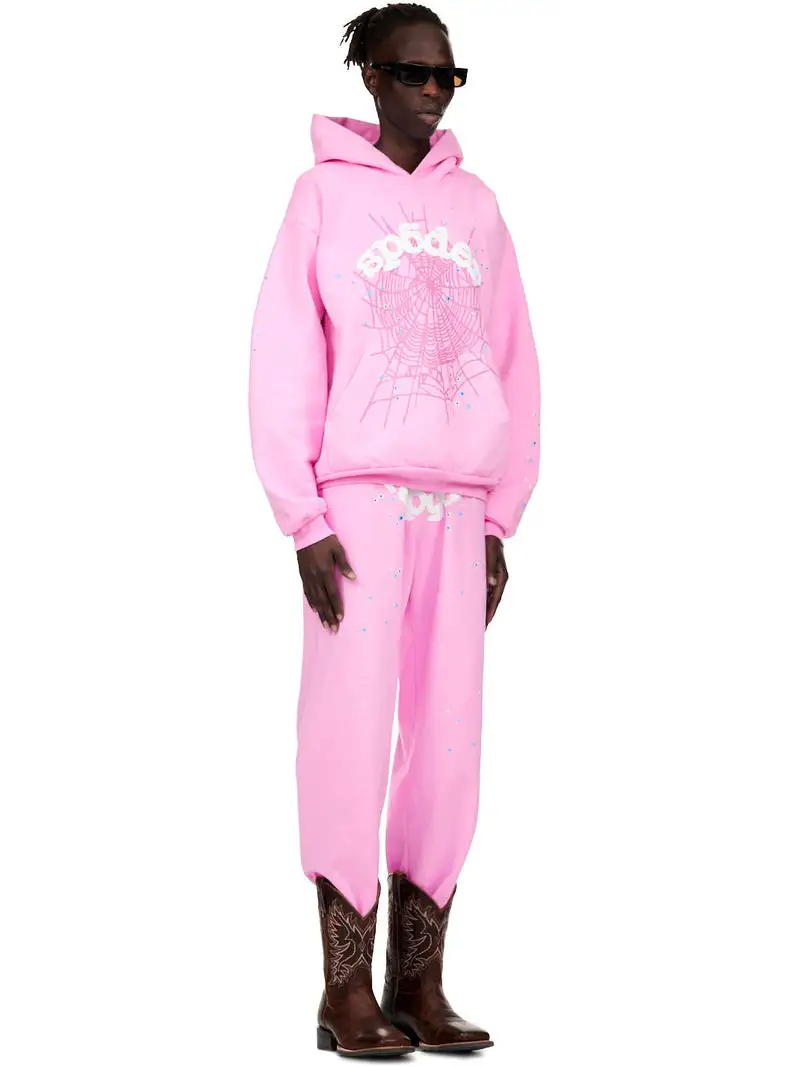
From the urban fashion angle of the analysis, Sp5der’s qualifications are virtually undeniable, and its resonance with fundamental streetwear elements is clear in almost every element of how the label operates. Limited-quantity mechanics is the most visible signal: launching finite amounts of pieces at irregular intervals to create purchasing rushes is the distinctive signature of streetwear, from Supreme to Palace to Sp5der. The visual identity — vivid images, spider web graphics, saturated color schemes, boxy shapes — borrows purely from the street art, skating, and urban music visual traditions that led to street fashion as a movement. The founding history is street culture entirely: a rap artist launches a brand that reflects his unique sensibility and social principles, establishing a community of like-minded followers around a common visual identity. The primary sales channel — a direct-to-consumer website with intermittent temporary installations — parallels how every key urban fashion brand delivers to its community since the internet allowed direct sales practical. The culture that develops around sp5der clothing — following new pieces, arguing about color variants, racing to secure garments at standard pricing — is essentially comparable to the communities that develop around Supreme, Bape, and every other brand that influenced street fashion history over the preceding thirty years. Sp5der’s retail prices is more than mass street fashion but less than legacy designer price points, which establishes it in the upper-echelon street fashion tier that has developed consistently since Kanye West demonstrated with Yeezy that street fashion can reach luxury-adjacent prices while preserving its community origins.
The Case For Classifying Sp5der as a Luxury Label
Despite its urban fashion roots, there is a credible position to be presented that Sp5der has stepped into high-end territory — or at minimum into a emerging category that requires a new set of terms. The secondary market prices for the most in-demand sp5der hoodies rise into the hundreds and sometimes even thousands of dollars, positioning them in a cost bracket that matches real high-end items by most measure. The community cachet connected to having an authentic sp5der hoodie at retail — the insider familiarity essential, the difficulty required, the community validation it earns — reflects the type of social signal dynamics that have always been core to the way luxury items serve among consumers. The brand continues to be written about in fashion publications that routinely focus on the luxury sector, suggesting that the fashion world’s own gatekeepers of style have accepted Sp5der into a narrative traditionally reserved for more prestigious brands. The clear sign that knockoff production is rampant in the sp5der space is a indirect endorsement of premium desirability: fakes spread where originals possess real prestige, and the knockoff ecosystem around sp5der clothing is equally advanced as the one around Louis Vuitton or Gucci. Younger shoppers in 2026 habitually commit sp5der premium on items they regard with the equivalent consideration and regard that earlier shoppers held for high-value luxury products — keeping them carefully, watching their value, and putting on them only in appropriate context. The mental association that dedicated enthusiasts have with their sp5der hoodies is the same from how luxury consumers feel about their most valued garments, regardless of what tier name the label officially holds.
Sp5der Compared to Classic High-End: A Direct Breakdown
| Factor | Traditional Luxury (e.g. Gucci) | Sp5der |
|---|---|---|
| Price point | $500–$5,000+ per item | $150–$350 retail; elevated on aftermarket |
| Sales model | Exclusive retail spaces, department stores | Online launches, intermittent activations |
| Background | Many decades of fashion heritage | Started early 2020s by Young Thug |
| Limited availability model | High cost + limited availability | Limited quantities + limited-drop mechanics |
| Community status | Wealth and prestige expression | Insider knowledge and community belonging |
| Core market | Well-off adults, 25–55+ | Youth 16–30, street culture and streetwear community |
| Fake economy | Significant (Vuitton, Gucci, Chanel) | Substantial and increasing |
The Premium Street Fashion Space: The Space Where Sp5der Genuinely Operates
The most accurate answer to the luxury-or-streetwear question is that Sp5der inhabits a tier that had no a established name until the last decade: top-tier streetwear. High-end urban fashion refers to brands that are culturally rooted in urban fashion’s origins and world but work within cost structures, cultural prestige levels, and material benchmarks that considerably exceed what the word “streetwear” historically meant. The tier’s key members include brands like Rhude, Fear of God, and the upper levels of Kanye West’s Yeezy label — labels that emerged out of rap and urban culture but now achieve pricing and community influence that blur the historical distinctions. The factor that sets apart elevated street fashion from high-end designer is chiefly the heritage narrative and the sales method: high-end labels possess lineage and restricted retail environments; high-end street fashion names offer social connection and web-based retail. What sets apart it from classic street fashion is price point, construction requirement, and social vision. Sp5der suits this structure precisely — it is pricier than and too culturally significant to be categorized with fast-fashion streetwear brands, but too community-rooted and community-based to be placed alongside Gucci or Louis Vuitton. Based on Business of Fashion’s analysis of the premium streetwear sector, names in this segment are the fastest-developing section of the international style market, outpacing both established designer and mass-market apparel in revenue increase and shopper demand. Sp5der’s place in this space is both secure and culturally meaningful in 2026.
The Reason Why the Response Really Is Relevant to Buyers
Understanding the space in which Sp5der falls on the luxury-streetwear scale is not merely an theoretical labeling exercise — it creates concrete effects for how consumers engage with and commit to the name. Should Sp5der be mainly a streetwear brand with elevated price points, shoppers would reasonably question whether the added investment is reasonable entirely because of material standards, and the answer would be uncertain at most. Should it be practically a social designer item — where the cost embodies status currency and public communication force as opposed to construction expense — then the logic changes fundamentally, and the added expense becomes more justified within its own logic. Shoppers who consider sp5der clothing as top-tier streetwear — paying for insider connection and self-expression as much as for the tangible product — typically feel far more satisfied with their buys than shoppers who evaluate it merely as a product. The label’s placement also shapes aftermarket activity: top-tier streetwear with genuine cultural capital appreciates more consistently long-term than fashion-forward products from names with shallower cultural depth. In 2026, the most helpful framework for approaching Sp5der is as a new version of premium — a kind defined by community awareness, group connection, and drop-model engagement instead of heritage heritage and branded retail access. That rethinking doesn’t undermine the label; actually, it renders it more interesting as a creative and industry phenomenon worth recognizing on its unique basis.